


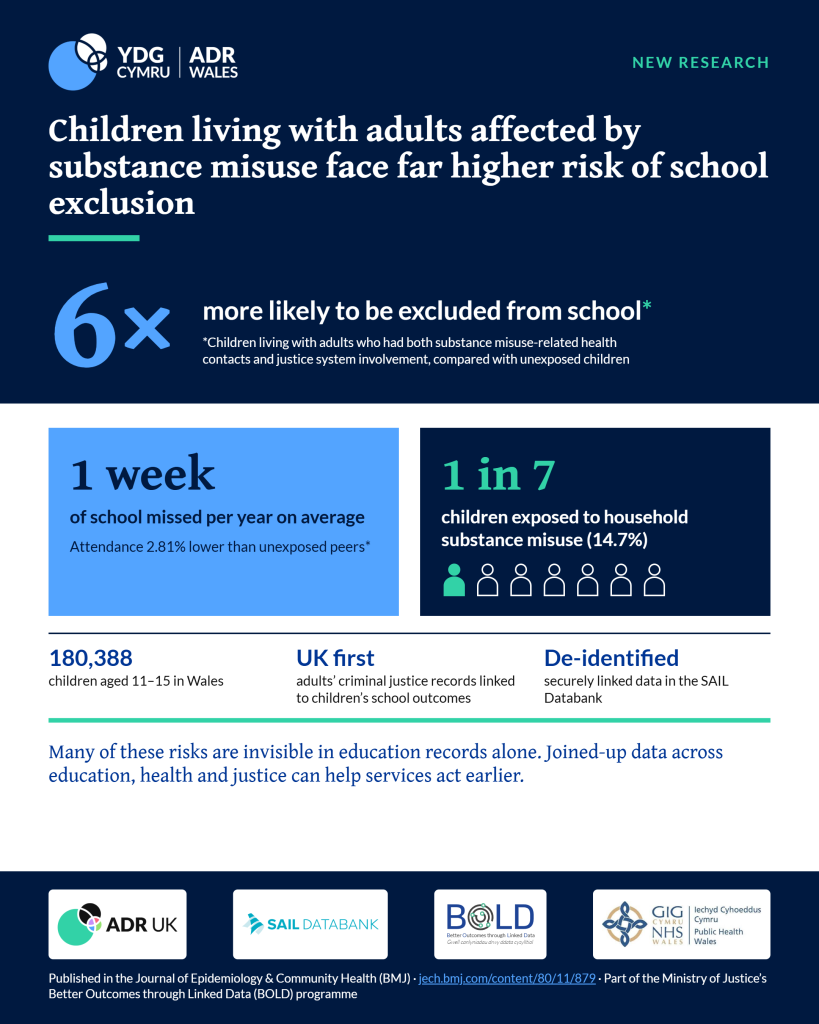
Children living with adults affected by substance misuse and involvement in the criminal justice system are significantly more likely to experience educational disruption, according to a landmark UK study.
Researchers from Administrative Data Research Wales (ADR Wales) and the SAIL Databank, found that children living with adults who had both substance misuse-related health and criminal justice records, had markedly poorer school outcomes than their peers.
Examples of poorer school outcomes included lower attendance rates, equating to missing over a week of school per year, along with more than six times the likelihood of being excluded.
This is the first time in the UK that researchers were able to explore the relationship between adults’ criminal justice records and the educational outcomes of children living in the same household using securely linked administrative data at a population-level scale. The findings highlight how household adversity can affect children’s engagement with education and point to the need for earlier identification and more coordinated support across public services.
Published in the British Medical Journal of Epidemiology and Community Health, the study analysed linked de-identified data from 180,388 children aged 11 to 15 in Wales. The research found that approximately one in seven children (14.7%) lived with an adult who had a substance misuse event recorded.
Children living with adults who had both substance misuse-related health and criminal justice system contacts experienced the poorest educational outcomes. Compared with unexposed children, their school attendance was reduced by an average of over 5 days (2.81%), and they were more than six times more likely to be excluded from school. The study also found that deprivation contributed to poorer educational outcomes and amplified the negative effects of household adversity. Importantly, many of these risks remain invisible within education records alone.
Study lead Dr Ian Farr said: “Our findings suggest that as education, health and justice services are not well-connected, they leave vulnerable children unidentified. This evidence strengthens the case for improved cross-sector data sharing, earlier intervention, and more integrated support services to help prevent educational disengagement and reduce the intergenerational long-term impact on children.”
Dr Emma Gordon, Director of ADR UK, said, “This research marks an important milestone for linked data research in the UK. For the first time, we have been able to look at the educational outcomes of children alongside information about the substance misuse and criminal justice experiences of the adults they live with, while maintaining the highest standards of privacy and security.”
Fellow study author, Dr Hywel T Evans said “Our studies have shown that substance misuse in a household is associated with not only poorer child health and wellbeing, but also worse educational outcomes. These findings directly align with key priorities from the Welsh Government’s Programme for Government 2026-2030, which places great importance on removing siloed working to provide better services and a better future for the people of Wales. By bringing together data from different parts of the public sector, we are generating evidence that helps policymakers identify opportunities for earlier intervention and more joined-up support for families.”
Working in collaboration with partners across government and academia as part of the Ministry of Justice’s Better Outcomes through Linked Data (BOLD) programme, the study linked health, criminal justice and education data to provide a more complete understanding of the factors that shape children’s life chances.
The newly published paper builds on an earlier study by the same research team, which found that children living with adults who misuse alcohol or drugs experience substantially higher levels of deprivation, poorer birth outcomes, increased mental health problems, greater involvement with social care services and a higher likelihood of being exposed to suicide. Those findings highlighted the profound impact that adverse experiences within the household can have on children’s health and wellbeing and underscored the need for early intervention to break cycles of intergenerational disadvantage.
By studying the same population and extending the analysis to educational records, the new research provides important insights into how household circumstances may influence children’s experiences and outcomes in school. Together, the two studies offer one of the most comprehensive pictures yet of the relationship between adult substance misuse within households and the long-term outcomes experienced by children in the UK.
The research demonstrates the unique value of securely linked administrative data in answering complex societal questions that cannot be addressed through individual datasets alone. As governments across the UK continue to explore data-driven approaches to public policy, the study showcases the value of collaborative initiatives such as the UK Government Ministry of Justice’s Better Outcomes through Linked Data (BOLD) programme, ADR Wales and SAIL Databank in creating robust evidence that can inform services, support prevention and improve outcomes for future generations.
The study used anonymised, population-scale linked data held within the SAIL Databank to help understand intergenerational disadvantage.
This study builds on research undertaken through BOLD, which seeks to improve the connectedness of government data across England and Wales. The research was supported through longstanding partnerships involving ADR Wales, Public Health Wales and the SAIL Databank.
Full details of the study can be found here.
More publications from the BOLD in Wales team.